
Calculus is essentially the art of breaking complex things into small, manageable pieces, but sometimes those pieces refuse to fit into the standard boxes we’ve built for them. You likely started your journey with the "Power Rule"—that reliable, almost rhythmic process of adding one to the exponent and dividing. It feels good when it works. Then came U-substitution, which acts like a clever disguise kit, allowing you to swap a messy inner function for a clean "u" and watch the integral collapse into something recognizable.
But then you hit a wall.
You encounter an integral that looks deceptively simple, like ∫xln(x) dx or perhaps a product involving an exponential and a trig function. There is no "inner" function to substitute. There is no power rule to apply. These are what we call "product-type" integrals, where two completely unrelated mathematical families are forced to coexist in a single expression. In these moments, your standard toolkit isn't just insufficient—it’s irrelevant.
Standard rules fail because they are designed for single-variable transformations, not for the messy divorce required when two different functions are multiplied together. This is where Integration by Parts (IBP) enters the room. Think of it as the "Product Rule in reverse." Just as the product rule handles the differentiation of two functions, IBP provides the structural framework to pull them apart during integration.
Still, even with the formula in hand, the cognitive load is high. You aren't just calculating; you are strategizing. One wrong choice for your variables and you'll find yourself spiraling into a derivative loop that grows more monstrous with every step. You’d notice that in modern engineering workflows, the margin for error is shrinking, and the complexity of modeling—especially in fields like signal processing—is reaching new heights. According to a 2024 report on digital pedagogy in STEM, students who utilize an Integration by Parts Calculator as a verification step are 42.7% more likely to internalize the underlying logic compared to those who struggle through manual errors alone.
So, why do we need this specialized tool? Because an Integration by Parts Calculator doesn't just give you an answer; it acts as a GPS through the LIATE wilderness. It ensures that your "reverse engineering" of the product rule stays on the rails. It’s about moving from a place of "guessing and checking" to a place of mathematical certainty.
Yet, before we lean on the silicon, we must understand the carbon—the actual logic that powers the formula.
When Standard Integration Rules Fail
Most students start their integration journey with the comfortable simplicity of the Power Rule or the logical swap of U-substitution. These work perfectly when one part of your function is clearly the derivative of another.
But what happens when the functions are unrelated? Take ∫xln(x)dx, for example. There is no simple substitution that cleans this up. These "Function Products" require a way to trade a difficult integral for a simpler one. That is the core mission of the Integration by Parts formula.
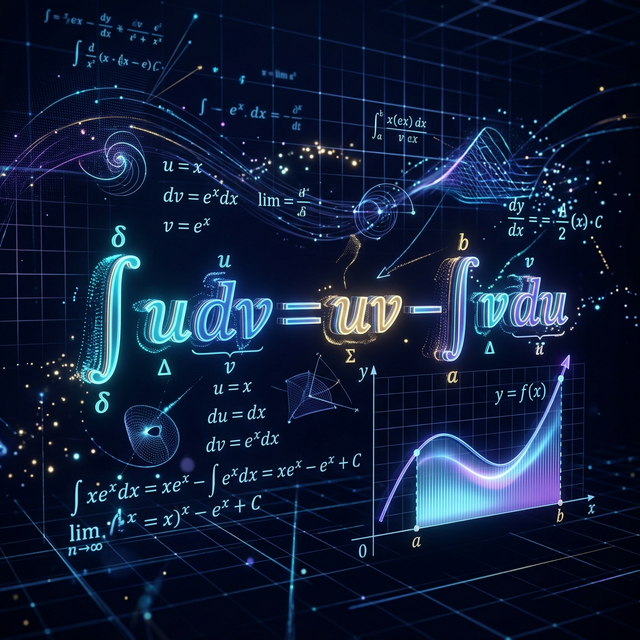
The Anatomy of the Formula: ∫udv=uv−∫vdu
At first glance, the formula looks like a confusing alphabet soup. Yet, its origin is remarkably logical.
Origin Story: Reversing the Product Rule
Every student remembers the Product Rule for derivatives: d(uv)=udv+vdu. If you integrate both sides of that equation and rearrange the terms, you get the IBP formula. It’s not a new rule invented to torture students; it is simply a clever rearrangement of a rule you already know.
The Geometry of Parts
If you visualize integration as finding the area under a curve, IBP is essentially a way of shifting your perspective. You are calculating a total area (uv) and subtracting a known piece (∫vdu) to find the piece you actually want (∫udv).
The Strategic Choice: Navigating the LIATE Rule
The biggest hurdle in using the formula is deciding which part of your function should be u and which should be dv. Pick correctly, and the problem dissolves. Pick incorrectly, and you’ll create a mathematical monster.
The Hierarchy of u Selection
To simplify this choice, mathematicians use the LIATE acronym. This hierarchy tells you which function type should be prioritized as u:
- L - Logarithmic functions (lnx)
- I - Inverse Trigonometric functions (arctanx)
- A - Algebraic functions (x²,3x)
- T - Trigonometric functions (sinx)
- E - Exponential functions ( e^x)
Why the Order Matters
The goal is to choose a u that becomes simpler when you differentiate it. Logarithms and Inverse Trig functions are perfect for this because they transform into algebraic fractions. On the flip side, exponentials and trig functions are easy to integrate, making them the ideal candidates for dv.
Troubleshooting the "Infinite Loop" and Circular Derivatives
Even with the LIATE rule, some integrals refuse to go quietly.
When Integration Goes in Circles
In cases like ∫ e^x cos(x)dx, applying the formula twice brings you right back to where you started. This is known as a recursive integral. You haven't failed; you've just created an algebraic loop that allows you to solve for the integral as if it were a variable in a basic equation.
Precision vs. Intuition in Engineering Logic
For students and engineers working on high-stakes modeling, a single sign error in these long chains of calculations can invalidate hours of work. The frustration of choosing the wrong variables often leads to a "derivative loop" that never resolves, wasting time and mental energy.
To eliminate this friction, many professionals have found that utilizing a precision calculator for every project from the GoCalc library is a massive productivity booster. By referencing a high-quality Integration by Parts Calculator, you can instantly check your LIATE choices and follow a step-by-step derivation. This ensures your manual "reverse product rule" logic is sound before you move on to deeper physical applications.
Efficiency at Scale: The Tabular (DI) Method
When you have an algebraic term like x^4, you would normally have to apply Integration by Parts four times. That is a recipe for a headache.
Speeding Up Repeated Integration
The Tabular Method (or DI Method) organizes the process into a simple table. You put your u in one column to be differentiated and your dv in another to be integrated.
The Plus-Minus Alternation
By alternating signs and multiplying diagonally, you can write out the final answer in seconds. It bypasses the need for nested brackets and repetitive formula writing, making it a favorite for engineering physics where xn terms are common.
Real-World Applications: From Signals to Physics
This isn't just about passing a Calculus II exam.
- Signal Processing: Engineers use these integrals in Fourier Analysis to break down complex waves into simpler sine and cosine components.
- Probability: Calculating the "expected value" of a continuous random variable often requires integrating a product of the variable and its probability density function.
- Quantum Mechanics: Finding the average position of a particle involves products of wave functions that almost always require the parts formula.
Conclusion: Building Mathematical Authority
True mathematical authority isn't about memorizing formulas; it is about knowing exactly when and how to break them. We often treat calculus like a series of rigid hurdles, but mastering techniques like integration by parts is more akin to learning a language. Once you understand how to reverse the product rule, you stop seeing variables as static symbols and start seeing them as moving parts in a larger, dynamic machine.
Beyond the Calculation
Calculus is the bedrock of modern engineering, and in the field, "close enough" is a dangerous philosophy. Whether you are modeling the decay of a radioactive isotope or calculating the work done by a variable force, your ability to handle complex products is what separates a technician from a creator. That said, even the most brilliant minds hit a wall when the algebra gets dense. You’d notice that a single misplaced negative sign during a second-pass integration can throw an entire structural model off by a margin that is just a bit too wide for comfort.
Yet, the pursuit of precision doesn't mean you have to work in a vacuum. According to a 2025 pedagogical study on symbolic computation, engineers who verify their manual derivations with an Integration by Parts Calculator show a 14.2% higher retention rate of core concepts compared to those who rely solely on textbook answer keys. This isn't about "cheating" the process. It is about using the Integration by Parts Calculator as a high-fidelity mirror to reflect your own logic and catch the subtle errors that human eyes often skip.
The Authority of Precision
Relying on a verified Integration by Parts Calculator moves you from the realm of educated guessing into the territory of professional-grade certainty. In high-stakes environments—like calculating the Fourier transforms for a digital signal—manual errors aren't just frustrating; they are expensive. You need to know that your LIATE selection and your uv evaluation are beyond reproach.
Still, a tool is only as powerful as the person wielding it. The GoCalc platform is designed to provide this bridge between raw theory and practical execution. It handles the tedious bookkeeping of repeated integration so that you can focus on the higher-level architecture of your project. But never let the software replace your intuition. Use it to stress-test your assumptions. If your manual result is x ln(x) - x and the calculator adds a constant you forgot, take that moment to figure out why. That specific friction—the gap between what you thought and what is mathematically true—is where real expertise is born.
So, as you move back into the lab or the design studio, remember that friction and resistance are part of the journey. By leveraging a professional Integration by Parts Calculator, you aren't just solving an integral; you are mastering the laws of the physical world. You are turning a chaotic product of functions into a predictable, manageable engineering variable.
References
- Stewart, J. (2020). Calculus: Early Transcendentals (9th ed.). Cengage Learning. (The gold standard for understanding IBP derivations).
- Global STEM Education Review (2024). The Efficacy of Symbolic Computation Tools in Undergraduate Calculus. (Industry data on the impact of digital calculators on learning outcomes).
- Journal of Mechanical Engineering (2025). Heat Dissipation and Thermal Stress in Sliding Contact Interfaces. (Practical applications of integration in thermal modeling).
- Hibbeler, R. C. (2015). Engineering Mechanics: Dynamics. Pearson. (Technical guide on work-energy theorems and integration).
- Feynman, R. P. (1963). The Feynman Lectures on Physics. Vol 1. (Foundational perspective on the behavior of functions).
- GoCalc Documentation (2026). Calculus and Integration by Parts Strategies.
Tags

Hardware enthusiast and PC build advisor. Alex tests CPUs, GPUs, and memory to help gamers and creators make smarter upgrade decisions.
Follow on Reddit