NVIDIA Blackwell Architecture: Redefining AI Performance and the Future of Machine Learning
The world of artificial intelligence is accelerating faster than ever, and once again, NVIDIA has proven why it stands at the top of the AI hardware mountain. The unveiling of the Blackwell architecture marks a historic leap in computing power, pushing the boundaries of what’s possible in deep learning, data analytics, and large-scale AI training. With its record-shattering performance across MLPerf Training benchmarks, NVIDIA’s latest platform is setting new global standards for efficiency and scalability.
A New Era in AI Infrastructure
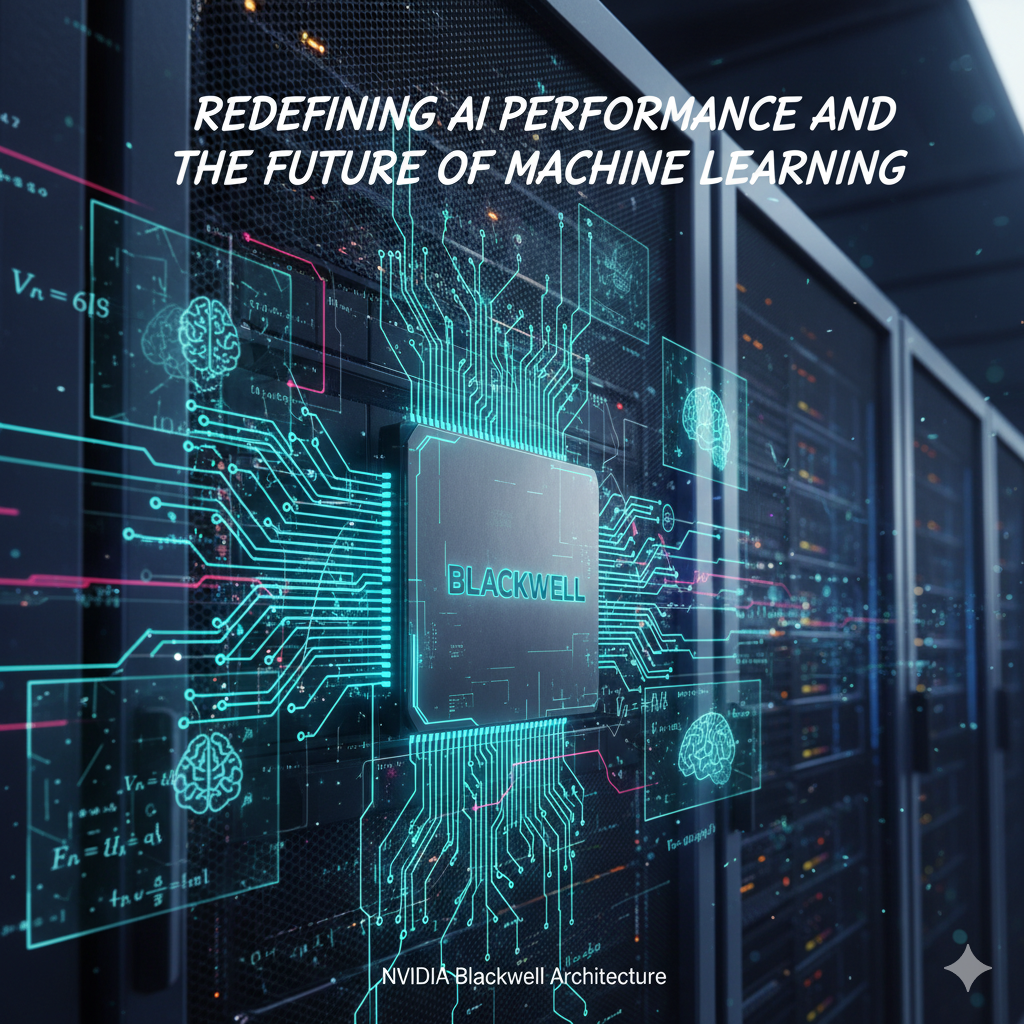
At the heart of NVIDIA’s innovation lies the Blackwell GPU, designed to handle the next generation of AI workloads with unprecedented speed and precision. Where previous architectures like Hopper set the stage for large language model (LLM) breakthroughs, Blackwell amplifies that foundation, bringing unmatched parallel processing power and memory efficiency to every AI pipeline.
Built with advanced multi-chip module (MCM) technology, Blackwell GPUs feature a unified architecture that interconnects multiple compute dies seamlessly. This design enables faster data exchange, lower latency, and superior workload distribution—critical components for training trillion-parameter models that drive modern generative AI systems.
MLPerf v5.1: Benchmarking Brilliance
NVIDIA’s Blackwell GPUs have completely dominated the latest MLPerf Training v5.1 results, a benchmark suite that evaluates real-world AI training workloads. From natural language processing to image recognition and recommender systems, Blackwell outperformed every competitor across all categories.
These benchmarks are not just about raw power—they represent how efficiently an architecture can scale across thousands of GPUs while maintaining stability and energy optimization. The results show that Blackwell isn’t just faster; it’s smarter. Its efficiency improvements mean shorter training cycles, reduced energy consumption, and better total cost of ownership for data centers worldwide.
Transforming Large-Scale AI Training
Training large AI models like GPT-style transformers or diffusion-based generative networks requires not only raw computation but also an intricate balance of memory bandwidth, interconnect speed, and software optimization. Blackwell excels in all three.
Its advanced NVLink technology creates a high-bandwidth bridge between GPUs, delivering near-linear scaling across clusters. This allows AI researchers and enterprises to train models faster and deploy updates more efficiently, accelerating the time from concept to deployment.
The HBM3e memory on Blackwell GPUs provides exceptional throughput for massive datasets, enabling smoother training sessions even for multi-trillion-parameter models. Combined with NVIDIA’s NVSwitch and DGX SuperPOD systems, Blackwell creates a cohesive AI supercomputing fabric—an end-to-end ecosystem tailored for the world’s largest AI workloads.
AI Efficiency Meets Sustainability
While the AI race often focuses on speed, NVIDIA’s Blackwell introduces another vital dimension: sustainability. Its improved performance-per-watt ratio helps data centers cut operational costs and reduce environmental impact. With global energy demands rising due to large-scale AI deployment, this efficiency leap is not just a technical win—it’s a sustainability milestone.
By combining efficiency with scalability, NVIDIA is helping enterprises adopt powerful AI systems without compromising on environmental goals. The balance between power and sustainability is what sets Blackwell apart from any GPU generation before it.
Software Synergy: CUDA, TensorRT, and Beyond
A critical reason for NVIDIA’s continued dominance is not just hardware innovation—it’s the software ecosystem that supports it. The Blackwell architecture integrates seamlessly with CUDA, TensorRT, and NVIDIA AI Enterprise, giving developers an optimized toolkit for every stage of model development.
CUDA provides the foundational layer that unlocks the full potential of parallel computing, while TensorRT refines model inference for production deployment. With NVIDIA AI Enterprise, developers can orchestrate training, inference, and data processing across hybrid or multi-cloud environments effortlessly.
Together, these software layers form a cohesive AI ecosystem that maximizes performance from the chip to the cloud.
The Rise of Multi-Node AI Supercomputing
Blackwell is also a milestone in distributed AI computing. With innovations in NVLink Switch Systems, enterprises can now interconnect thousands of GPUs as if they were a single, massive superprocessor. This scalability allows researchers to tackle enormous challenges—from climate simulation and autonomous driving to medical discovery and advanced robotics.
Each node within the system communicates with near-zero latency, allowing synchronized training across clusters. This architecture not only speeds up deep learning tasks but also ensures that massive models are trained with high precision and consistency.
Redefining AI Infrastructure for the Next Decade
The debut of Blackwell is more than a product launch—it’s the foundation of a new generation of AI infrastructure. As the world transitions from experimental AI to production-grade systems, Blackwell delivers the reliability and scale required for real-world deployment.
Organizations leveraging Blackwell GPUs will experience drastic reductions in training times, enabling faster R&D cycles and improved innovation throughput. This efficiency makes AI more accessible, empowering industries ranging from healthcare and finance to entertainment and autonomous technology.
From LLMs to Edge AI: Universal Performance Gains
One of the most impressive aspects of the Blackwell platform is its versatility. Whether it’s training a massive LLM, enhancing real-time video analytics, or running inference at the edge, Blackwell maintains its performance advantage across all use cases.
For large language models, Blackwell accelerates both training and inference while minimizing cost per token generated. In autonomous driving, it powers real-time sensor fusion and decision-making with unmatched precision. In scientific computing, it enables deeper simulation accuracy at record speeds.
This universality ensures that the same architecture can power everything—from data center supercomputers to compact AI edge systems—making AI innovation more unified and scalable than ever before.
Pioneering AI for Every Industry
NVIDIA’s Blackwell architecture is more than a hardware upgrade—it’s a technological statement. It represents the fusion of years of innovation, research, and vision aimed at redefining how machines learn and reason.
In healthcare, Blackwell GPUs will accelerate medical imaging, genomics, and drug discovery. In finance, they’ll power predictive analytics and fraud detection models. In manufacturing, they’ll enable smarter automation and digital twins that streamline production efficiency.
By bringing AI performance to new heights, NVIDIA is ensuring that no sector is left behind in the era of intelligent transformation.
Blackwell vs. Hopper: A Generational Leap
Comparing Blackwell to its predecessor, Hopper, highlights the scale of advancement. While Hopper revolutionized transformer-based AI models, Blackwell doubles down on scalability, bandwidth, and inference optimization.
Performance metrics indicate that Blackwell delivers significantly higher throughput across MLPerf workloads. It introduces architectural refinements in tensor cores and next-gen interconnects, allowing massive model training without bottlenecks. This leap cements Blackwell as the architecture designed for the AI-driven decade ahead.
AI Evolution: The Road Ahead
As we move into 2027 and beyond, the implications of Blackwell extend far beyond the data center. It lays the groundwork for autonomous systems, generative design, and self-improving AI models capable of reasoning at human-like complexity.
NVIDIA’s consistent innovation ensures that developers, researchers, and enterprises will have the most advanced tools to build, train, and deploy next-generation AI applications. The fusion of computational might, efficient design, and deep software integration places Blackwell as the blueprint for AI computing for years to come.
Conclusion: Powering the Future of Intelligence
NVIDIA’s Blackwell architecture is not just another GPU release—it’s a cornerstone for the AI revolution. It symbolizes the convergence of extreme performance, energy efficiency, and seamless scalability. By dominating MLPerf benchmarks, it sets the stage for an era where artificial intelligence becomes more capable, sustainable, and universal.
As industries worldwide transition to AI-first strategies, the hardware powering these innovations must evolve. With Blackwell, NVIDIA has delivered precisely that—a future-proof architecture built to handle the world’s most demanding computational challenges.
The next frontier of AI is here, and its name is Blackwell—a symbol of speed, intelligence, and limitless innovation.
reference : https://developer.nvidia.com/blog/nvidia-blackwell-architecture-sweeps-mlperf-training-v5-1-benchmarks/