Microsoft Taps OpenAI’s Custom Chip Effort — The Strategy Behind the Move
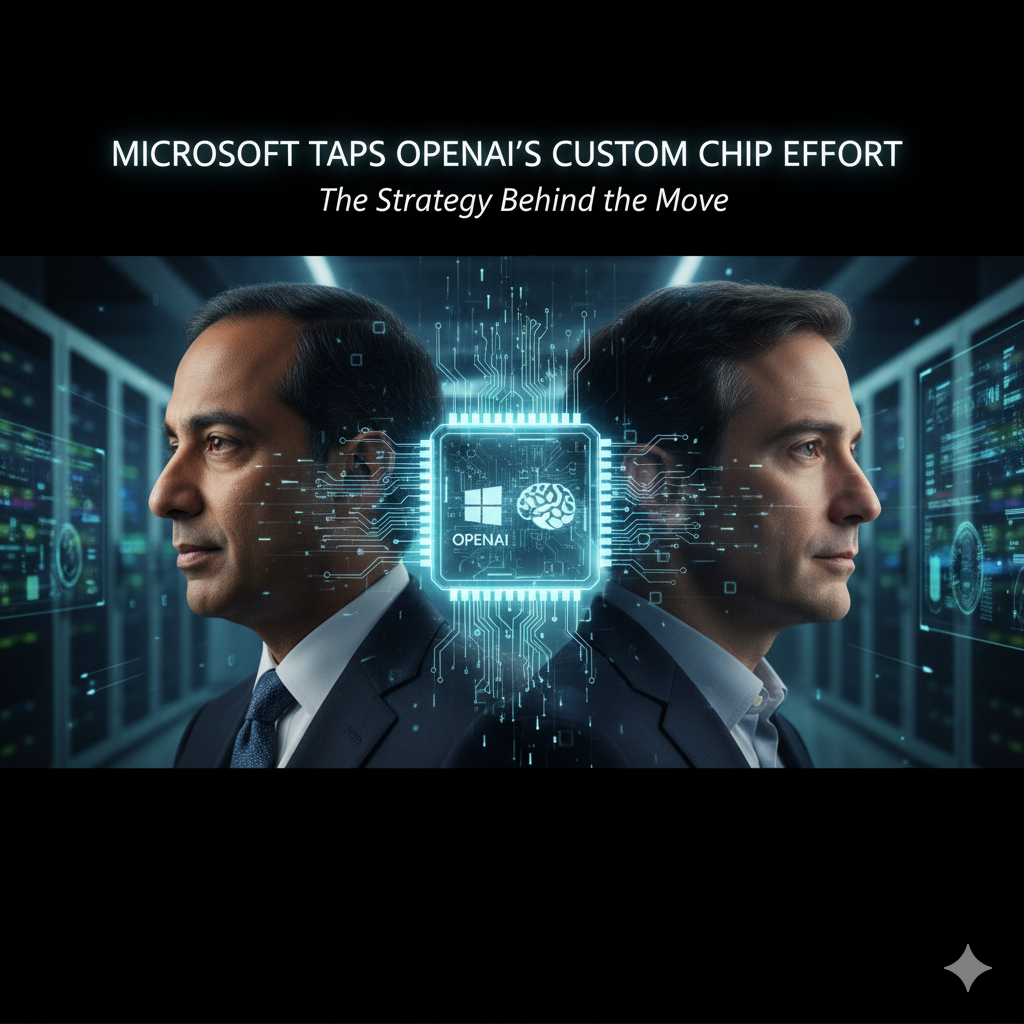
In the rapidly evolving world of artificial intelligence (AI), hardware is just as critical as algorithms. This week, Microsoft made a significant move: rather than relying solely on external hardware providers, Microsoft will use OpenAI’s custom-chip development as a springboard for its own in-house semiconductor ambitions.
This move signals more than a change in hardware sourcing. It reflects a shift in how major tech companies view infrastructure, control, cost, and competitive advantage. For businesses, marketers, website designers, and global brands (including those in Pakistan, Latin America and elsewhere) it means the underlying foundations powering AI-enabled experiences are shifting — and the ripple effects will matter.
What’s Happening?
Microsoft CEO Satya Nadella announced that Microsoft will gain access to OpenAI’s custom semiconductor designs and system-level innovations. Essentially, Microsoft will first instantiate what OpenAI has built for its own needs, and then “extend it” into its own chips and hardware roadmap.
OpenAI has been developing custom AI accelerators (with external partners) to optimize inference and training of large models. Microsoft’s access to that IP means they can leap-frog certain design stages, reduce duplicated effort, and align hardware more tightly with their cloud and AI services platform.
Why This Matters Strategically
1. Reducing Dependency & Cost
Historically, most AI infrastructure has leaned heavily on a small set of hardware vendors. Licensing and manufacturing costs are enormous, and margins matter. By collaborating (or drawing from OpenAI’s designs) Microsoft is moving toward greater optionality: they can still buy third-party hardware when needed, but also develop bespoke or semi-bespoke chips tailored to their services. This can reduce per-unit cost, improve power efficiency, and give them more control over supply chains.
2. Moving from Software to Hardware Integration
Microsoft is known for software, cloud services and productivity platforms. But as AI becomes more central, hardware becomes a strategic asset. Enabling custom semiconductors means Microsoft can better optimize latency, throughput, inference cost and scale for its own Azure cloud, Copilot services, and enterprise AI offerings. It’s a move toward vertical integration in AI.
3. Control & Differentiation
If Microsoft can base part of its hardware roadmap on OpenAI’s designs, it can differentiate its AI services from rivals. For example: faster inference, lower latency for real-time apps, or cost advantage that can be passed down. In a world where many companies use similar software stacks, hardware becomes a differentiator.
4. Implications for Competitors
This move sends signals to other major players (for instance big cloud/AI providers) that the race is not just for models or software frameworks—but for ownership of the compute stack. Competitors will watch whether Microsoft can execute this well, and whether the custom-chip route yields meaningful benefits.
Technical & Operational Implications
Custom Chip Access ≠ Instant Deployment
It’s important to note: Microsoft’s access to OpenAI’s custom chip work is not immediately removing the need for existing hardware vendors. Designing, manufacturing and integrating new chips at hyperscale takes time: tooling, validation, yield, packaging, ecosystem readiness all matter.
Software & Ecosystem Optimization
Hardware is one thing; making it useful is another. Microsoft will need to ensure that models, runtime systems, toolchains, cloud orchestration and dev-tools align with whatever custom hardware they deploy. Otherwise the hardware advantage may be throttled.
Infrastructure & Supply Chain Complexity
Even with design access, building out new chips and hardware platforms at scale involves contracts with foundries (e.g., TSMC), packaging, ecosystem support, cooling/power considerations and large CAPEX commitments. Microsoft’s move gives them optionality, but this is a strategic roadmap, not a guaranteed overnight transformation.
What This Means for Your Domain: Web, Global Brand & Multilingual Strategy
Since you’re interested in website design, multilingual homepages, global brand strategy (Spanish, German, Turkish, Arabic, Russian) and the broader tech ecosystem — here are direct implications for you:
Faster, smarter AI for your users
- If Microsoft’s cloud and AI services begin to use more efficient custom hardware, latency, compute cost and response time for AI-driven services will improve.
- For your multilingual website efforts, this means that smarter translation, real-time adaptation and AI-driven UX may become more affordable & faster to deploy—even for smaller regional players.
- A global brand (like your beauty/skin-care or multilingual site) can position itself as being “powered by the most advanced AI infrastructure” which can be a trust/quality signal in tech-aware markets.
Reduced cost & wider reach
- More efficient hardware means that Microsoft’s cloud services might deliver AI features at lower cost or higher scale. That could enable you (or your brand) to embed advanced features (e.g., AI-based translation, content generation, personalization) more easily.
- In markets like Pakistan, where infrastructure or budget constraints exist, the trickle-down effect of large cloud providers optimizing hardware means access to better services becomes more viable.
Content & marketing opportunity
- You could craft content around the theme of “behind the scenes” of global AI infrastructure: why your website cares about chip design, how regional brands get access to global-scale AI.
- Keywords might include: “custom AI hardware impact on global brands”, “multilingual websites enabled by next-gen AI infrastructure”, “cloud compute cost reduction for regional markets”.
- Use this hardware story as part of your value proposition: “Our platform uses the latest AI architecture backed by Microsoft’s custom chip roadmap” or “Global audience optimisation with next-generation infrastructure”.
Regional & Emerging Market Significance
In Pakistan and similar emerging markets, this kind of infrastructure shift has long-term importance:
- Historically, access to cutting-edge hardware, high cost of cloud compute, and latency issues have been barriers for local startups or brands.
- As major providers like Microsoft invest in custom or optimized hardware, the cost of serving AI/ML workloads may fall, leading to better infrastructure availability, better performance and perhaps lower pricing for regional players.
- For your brand, being early to adopt and talk about global-scale infrastructure readiness positions you ahead of regional competitors who might still rely on older hardware or slower cloud services.
Potential Risks & Things to Monitor
While the strategic move is strong, it’s wise to be realistic and watch for some caveats:
- Timeline uncertainty: Custom chip design and deployment takes years. Immediate benefit may be limited.
- Software lag: Hardware is only useful if software stacks, models and toolchains catch up.
- Ecosystem lock-in: If Microsoft’s hardware stack diverges significantly, compatibility and portability may become an issue for developers or brands relying on multi-cloud or multi-platform strategies.
- Competitive response: Other providers will react. For instance, cloud providers or open-source hardware initiatives may escalate. Keeping your strategy adaptable is key.
- Regional infrastructure: Even if global hardware improves, local issues (connectivity, power, regulatory, import costs) may still slow regional benefit.
What to Watch in the Next 12–24 Months
To see how this move plays out, here are some signs to monitor:
- Microsoft’s announcements of new AI hardware / chip families, especially citing designs informed by OpenAI.
- Cloud service tiering: Are there new “inference-optimized” tiers or “accelerator custom hardware” instances launched by Microsoft Azure?
- Price shifts for cloud-based AI/ML compute: If hardware efficiency improves, we may see lower cost per token or per inference.
- Performance benchmarks: Public results comparing Microsoft’s own hardware stack vs third-party GPUs.
- Impact on global developers: Are more regional startups getting access to advanced AI features once cost or latency barriers drop?
- Competition: How do Google, Amazon, other cloud providers respond? Do we see similar in-house chip efforts or partnerships?
How Brands & Developers Should Act
Given the hardware narrative shift, here’s how you can align:
- Stay infrastructure-aware: Even if you’re focused on websites/brands, understanding hardware trends helps you anticipate changes in cost, performance, features.
- Design for portability: As hardware evolves, you don’t want your stack locked into one vendor. Use abstractions (e.g., cloud-agnostic APIs), so you can switch or upgrade when needed.
- Optimise AI features: Explore how lower latency and better infrastructure might enable new features: real-time translation, dynamic content generation, personalised visuals/videos.
- Lead with tech-story: For your audience (especially tech-aware in multiple languages), tell the story of how you’re using global-scale AI infrastructure to benefit them.
- Budget for future-proofing: Infrastructure cost is shifting — allocate some budget/time to emerging features and platforms so you’re ready for the hardware wave when it hits your region.
Final Thoughts
Microsoft’s decision to tap into OpenAI’s custom-chip work is more than a hardware handshake — it’s a strategic pivot in how cloud, AI and infrastructure will evolve. For your global brand, multilingual web presence and tech-savvy audience, this matters: the pace of AI-driven user experiences is about to accelerate, cost-structures may shift downward, and global access will get more level.
In the coming years (2026-2028), being aligned with this infrastructure shift gives you an edge — not just in technology, but in storytelling, marketing and brand positioning. The future of AI isn’t just software; it’s increasingly hardware + software, and companies who understand both will lead.