
Quick answer
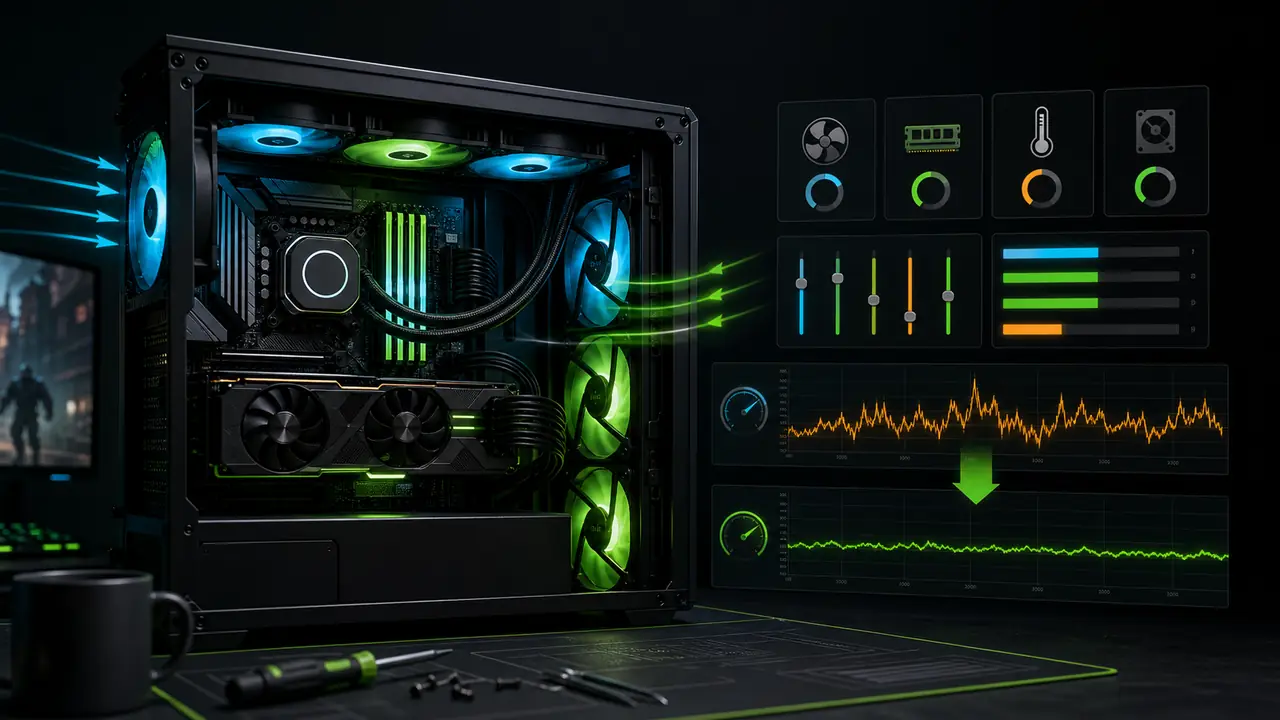
To reduce bottleneck in games, identify the limiting part first, then fix free issues before buying hardware. Check FPS caps, V-Sync, drivers, thermals, RAM channel mode, XMP/EXPO, background tasks, and game settings. Only upgrade after the same limit appears in multiple games.
Use the bottleneck calculator as a starting point, not as the final decision.
If the CPU is limiting
CPU limits often appear at 1080p high FPS. Reduce settings that increase simulation and draw-call pressure: crowd density, object distance, traffic, physics, AI, and some shadow settings. You can also cap FPS slightly below the unstable maximum to smooth frametime.
If your GPU usage stays low in several games and lowering graphics does not help, a CPU or platform upgrade may be reasonable.
If the GPU is limiting
GPU limits are common in 1440p and 4K. Lower ray tracing, render scale, shadows, reflections, volumetrics, and anti-aliasing. Use DLSS, FSR, or XeSS when image quality remains acceptable.
If the GPU is already near 100 percent and the game is smooth enough, there may be nothing wrong. The GPU is simply doing the main work.
If RAM is limiting
RAM bottlenecks show up as stutter, bad 1% lows, and inconsistent frametime. Check whether the system uses dual-channel, whether XMP/EXPO is enabled, and whether the game plus background apps fill memory.
Going from one stick to two matched sticks can help more than expected. Moving from 16 GB to 32 GB can also help modern games, mods, streaming, and multitasking.
If temperature is limiting
High temperature can reduce clock speeds. This looks like a bottleneck but is really thermal throttling. Clean dust, improve airflow, adjust fan curves, check cooler mounting, and monitor clocks under load.
Upgrade only after testing
Make a small test sheet: game, scene, resolution, graphics preset, FPS average, 1% low, GPU usage, CPU core usage, RAM, temperature. If the same component limits several games, upgrade that component first.
For diagnosis steps, read CPU vs GPU bottleneck test and how to read bottleneck percentage.
FAQ
Can I reduce bottleneck without upgrading?
Often yes. Settings, thermals, RAM configuration, and FPS caps can improve smoothness.
Should I lower graphics for CPU bottleneck?
Only some settings help. Lowering textures usually does little for CPU limits.
Does capping FPS help?
Yes, it can stabilize frametime when the system is bouncing between limits.
Should I upgrade RAM first?
Only if RAM is full, single-channel, too slow, or causing poor 1% lows.
Is GPU bottleneck bad?
Not always. In 1440p and 4K, high GPU usage is usually expected.
Tags

Our editorial team checks PC hardware calculations against benchmark data and explains CPU, GPU, RAM, and resolution limits separately.
Editorial methodology