
Quick answer
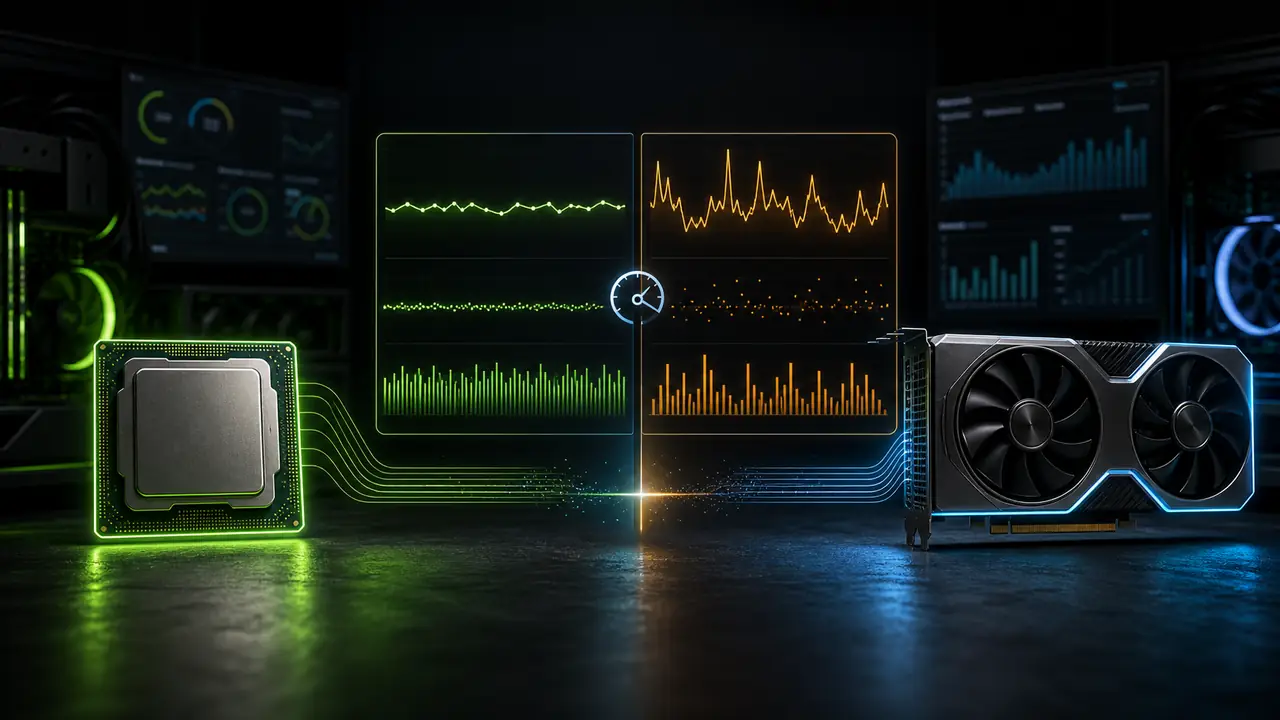
To test CPU vs GPU bottleneck, compare the same scene at two resolutions and watch GPU usage, CPU core usage, FPS, 1% lows, and frametime. If lowering resolution raises FPS a lot, the GPU was likely limiting. If FPS barely changes, the CPU, RAM, or game engine may be limiting.
Start with the bottleneck calculator to form a hypothesis, then use this test to confirm it.
Prepare the test
Choose a repeatable scene. A built-in benchmark is ideal, but a saved location in a game can work. Close background apps, keep drivers the same, and avoid changing multiple settings at once.
Track:
- average FPS,
- 1% low FPS,
- frametime graph,
- GPU usage,
- per-core CPU usage,
- RAM and VRAM usage,
- CPU and GPU temperatures.
Test 1: normal settings
Run the scene at your normal resolution and graphics preset. Write down the numbers. Do not judge only by average FPS. A high average with poor 1% lows can still feel bad.
If GPU usage is near 100 percent and the game is smooth, that is usually a GPU-limited scenario. In many games, that is expected.
Test 2: lower resolution
Now lower resolution or render scale while keeping the scene the same. If FPS climbs sharply, the GPU was the main limit. If FPS barely changes, the GPU was waiting and the limit may be CPU, RAM, or engine-side.
This test is especially useful when a user thinks a new GPU will fix everything, but the old CPU is already limiting high-FPS gameplay.
How to spot CPU limits
CPU bottleneck signs include low GPU usage, a few CPU cores heavily loaded, poor 1% lows, and little gain from lowering graphics. Strategy games, MMO hubs, big battle scenes, and competitive titles at high FPS often show this pattern.
How to spot GPU limits
GPU bottleneck signs include high GPU usage, clear FPS gain from lower resolution, and large impact from settings like ray tracing, shadows, reflections, and render scale.
Check RAM and heat
RAM and thermals can mimic CPU limits. If memory is full, single-channel, or running at default low speed, frametime can suffer. If CPU or GPU clocks drop because of heat, the fix may be cooling rather than a new processor.
For memory details, read single-channel vs dual-channel RAM. For interpretation, read how to read bottleneck percentage.
FAQ
How do I know if CPU is bottlenecking GPU?
GPU usage stays low, some CPU cores are heavily loaded, and lowering resolution does not improve FPS much.
How do I know if GPU is the bottleneck?
GPU usage is near 100 percent and lowering resolution or graphics improves FPS clearly.
Is total CPU usage useful?
Only partly. Per-core usage and frametime are more useful for games.
Can RAM look like CPU bottleneck?
Yes. Slow or single-channel RAM can hurt 1% lows and make the CPU look worse.
How long should I test?
Use at least 60 seconds per scene, or a full benchmark run if the game provides one.
Tags

Our editorial team checks PC hardware calculations against benchmark data and explains CPU, GPU, RAM, and resolution limits separately.
Editorial methodology